Autonomous Ice Resurfacers
PhD dissertation research · Current
Overview
My dissertation focuses specifically on autonomous ice resurfacers. These machines must cover a rink efficiently, interpret changing surface conditions, and apply the right amount of water while respecting vehicle and operational constraints.
The work will connect simulation and evaluation tooling with surface perception, coverage and service planning, localization uncertainty, and the integrity of the task-state data used to make resurfacing decisions.
The CARS 2026 paper is the first step in this dissertation. It establishes a fixed-route baseline and asks whether an autonomous resurfacer can trust the surface-demand map that controls its water allocation.
Research directions
- Task-state integrity and defenses for surface-aware water allocation.
- Simulation and evaluation environments for repeatable autonomous resurfacing experiments.
- Adaptive coverage and water-allocation methods that respond to spatially varying surface demand.
- Robustness to localization error, degraded observations, and changing rink conditions.
Task-state integrity
As the first dissertation study, the CARS 2026 paper isolates the service decision from navigation: the resurfacer follows a fixed route while an observed surface-demand map determines water allocation. False-positive and false-negative map attacks can therefore degrade service even when the route remains safe and deterministic.
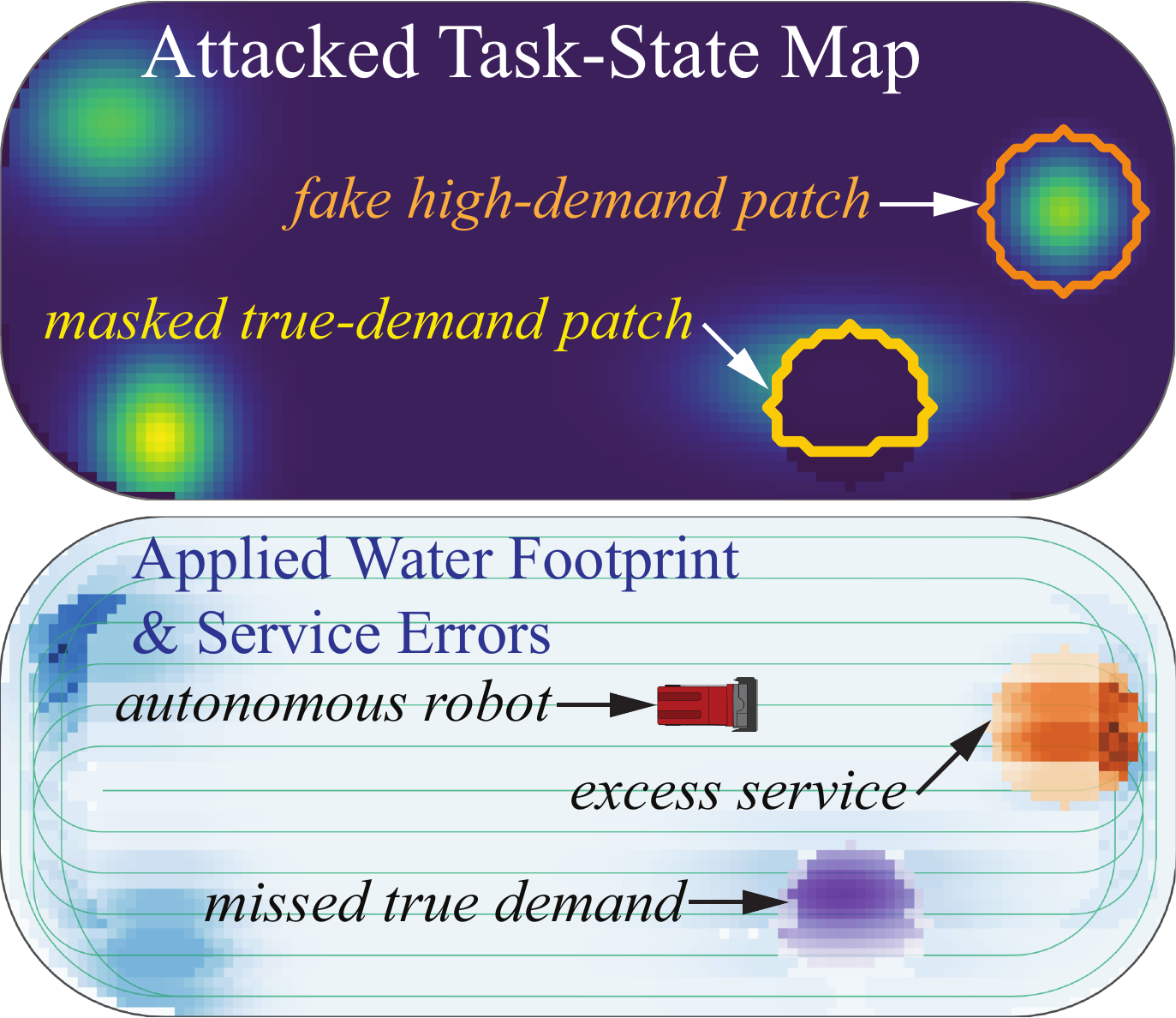
Bayesian smoothing reduced the effect of naive corruptions, but an attack shaped to the smoother's own kernel reversed that benefit. The evaluated low-cost filters exposed different false-positive and false-negative tradeoffs rather than a single dominant defense.
Publication
Task-State Integrity Attacks and Defenses for Fixed-Route Autonomous Ice Resurfacing
Michael Hajostek and Tingjun Lei
6th IEEE Cyber Awareness and Research Symposium (CARS 2026), 2026. Accepted for presentation.